Choral / 2023
Judith Beheading Holofernes
Composer
The story of Judith appears in the Roman Catholic and Easter Orthodox versions of the Old Testament, although not in the Hebrew canon or Protestant Bible. Judith, a Jewish widow whose city is threatened by the heathen general Holofernes, travels to the enemy camp, accompanied by only her maid. Holofernes is smitten with her. Once she has his confidence, Judith gets Holofernes drunk, beheads him with his own sword, and returns to her city.
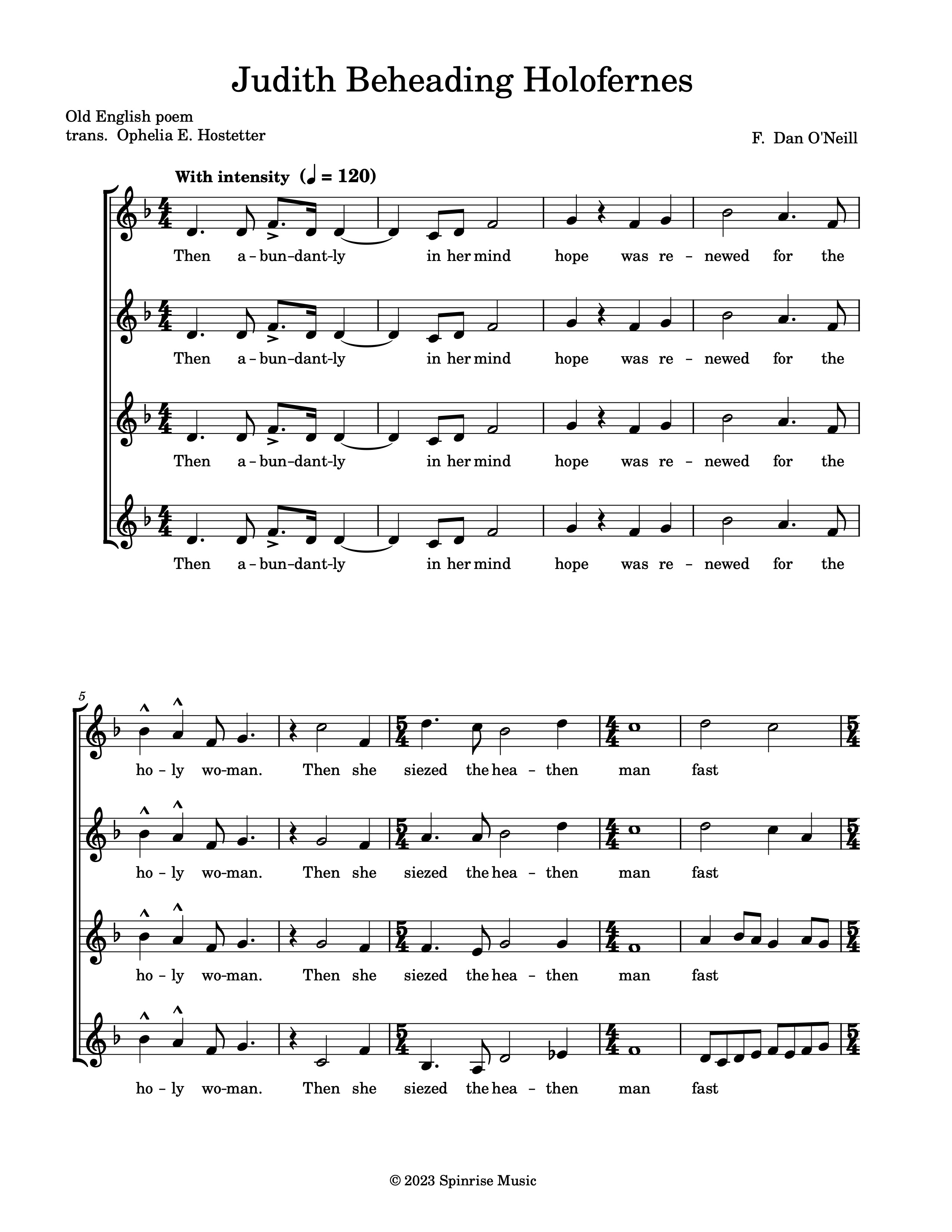
The text for this piece, however, is drawn not from the original Book of Judith, but rather from an Old English poetic treatment of the same story. The poem—found in the Nowell Codex, the same manuscript that gives us Beowulf—follows the plot of scripture, but it frames Judith’s defeat of the heathen general Holofernes as an epic tale of valiant struggle against and triumph over a monstrous foe, like Beowulf’s overthrow of Grendel. This choral setting takes inspiration from the heroic view of Judith, with energetic rhythms and joyous harmonies depicting the story as it might be recounted in celebration after the defeat of Holfernes’ now-leaderless forces.
Judith herself is something of an enigma. She defies easy characterization as either a femme fatale or a “warrior woman” in the mold of Joan of Arc. Judith assumes both roles at various points in the story, but she slips out of them as soon as their usefulness ends. Judith uses these reductive archetypes—feminine and masculine alike—as weapons against a hostile society eager to force her into a mold. Ultimately, Judith’s keystone virtue is not her beauty, cunning, or strength, but rather her courage and willingness to risk everything to protect those she loves.